

The question of why soil does not retain water is of concern to many growers, as moisture is often lost quickly, even with frequent irrigation, resulting in crop stress. When soil does not retain water, it is usually the result of a combination of physical, chemical, and biological factors. A soil’s ability to hold moisture depends on its structure, organic matter content, particle composition, and cultivation practices.
Soil water-holding capacity is critical for plant nutrition, as it determines how readily roots can access water. More information on the importance of soil water-holding capacity is available in the Michigan State University Extension article, “Why is soil water-holding capacity important?“
Soil does not retain water due to its texture.
One of the main reasons soil does not retain water is its texture. Sandy soils consist of large particles and wide pores, allowing water to drain rapidly to deeper layers before it can be maintained in the root zone. Soils with high sand content may dry out within hours after irrigation, even when large amounts of water are applied.
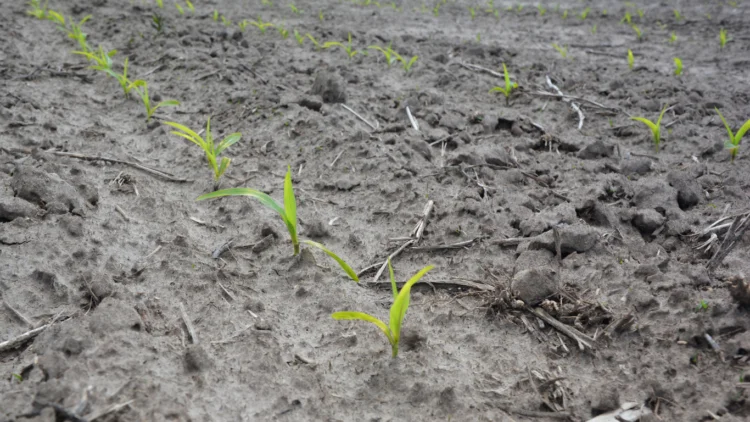
Why do clay soils also struggle to retain water effectively?
On the opposite end, heavy clay soils may also struggle with water retention, but for entirely different reasons. Clay particles bind water strongly through adhesion forces. However, when the soil becomes excessively compacted, its structure collapses, pore spaces are reduced, and water and air movement are restricted. Instead of infiltrating, surface water ponds evaporate, leaving deeper soil layers dry—creating the impression that the soil does not retain water.
Low organic matter and soil water holding capacity
Low organic matter is one of the most significant reasons soil does not retain water effectively. Organic matter acts like a sponge: it absorbs water, stores it, and gradually releases it to plant roots. Soils with organic matter levels below 1.5–2% tend to have poor structure, dry out quickly, crack, and show strong moisture fluctuations. Low organic matter also limits microbial activity, which is essential for forming stable soil aggregates.
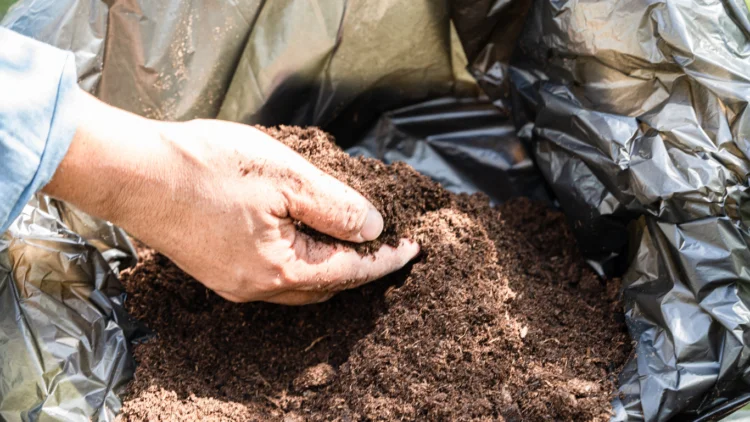
Soil Tillage and Compaction: Why Soil Does Not Retain Water
Repeated mechanical disturbance often leads to poor soil structure. Deep rotary tillage, plowing wet soil, and the use of heavy machinery lead to compaction. Compaction reduces macropores, restricts downward water movement, and creates a compacted layer—commonly referred to as a plow pan—at depths of 20–30 cm. This layer prevents water from penetrating deeper into the soil profile.
As a result, even with frequent irrigation, the soil does not retain water at depth. The surface dries quickly, while deeper layers remain inaccessible to roots. In such cases, irrigation alone is ineffective unless combined with proper soil and water management practices.
Soil pH, salinity, and water availability
Soil pH also affects water retention by influencing the stability of organic matter, microbial activity, and soil structure. Extremely acidic or alkaline soils have a limited capacity to form stable aggregates, resulting in surface crusting after rainfall or irrigation. This crust blocks water infiltration and increases surface runoff.
Soil salinity further reduces water availability. Salts bind water molecules, thereby decreasing the fraction available for plant absorption. In saline soils, water may be present but remains unavailable due to osmotic stress, making the soil appear dry despite containing moisture.
The lack of ground cover contributes to moisture loss.
The absence of ground cover is another key reason soil does not retain water. Bare soils are directly exposed to sunlight and wind, accelerating evaporation and surface drying. Ground cover—either living plants or crop residues—reduces moisture loss, stabilizes soil structure, and contributes to organic matter accumulation.
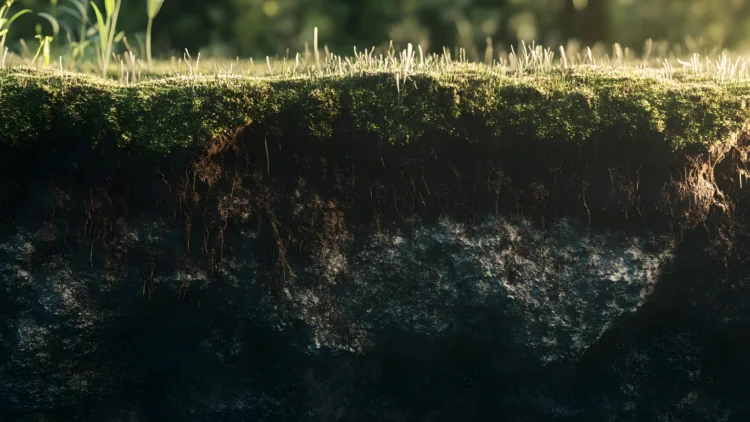
How to improve water retention when the soil does not retain water
Improving soil water retention requires a combination of practices aimed at restoring structure and increasing water-holding capacity:
- addition of organic matter, compost, or well-decomposed manure.
- permanent ground cover or mulching with plant residues.
- reduced or no-tillage practices.
- soil amendments that enhance water-holding capacity, such as zeolite.
- gentle cultivation methods that preserve pore structure.
- pH correction where necessary.
- irrigation applied at appropriate rates to prevent surface runoff.
Conclusion
When soil does not retain water, the solution is not increased irrigation but rather improved soil structure and water-holding capacity. Enhancing organic matter, adopting appropriate cultivation practices, and managing irrigation efficiently enable the soil to store water more effectively, supporting stable crop growth and resilience under challenging conditions.