

If you are wondering why olive trees are not growing, the answer usually lies in a few specific factors. The olive tree is one of the toughest trees of the Mediterranean. It can withstand drought, rocky soils, and neglect. However, when it does not grow properly, productivity suffers. Below are the 10 most common reasons that explain why olive trees are not growing, along with practical solutions and the scientific explanation behind each one.
1. Lack of water—a primary reason why olive trees are not growing
The simplest and most common reason why olive trees are not growing is water deficiency. Olive trees tolerate drought, but not when they are young or when they try to develop new shoots in spring. Without adequate moisture, new buds fail to develop properly, and growth remains limited.
Evidence: Studies (Zaragoza et al., 2011) have shown that water shortage in spring significantly restricts growth.
Solution: Apply deep irrigation in spring and early summer. Avoid frequent shallow watering; water less often but thoroughly.
2. Poor drainage
Too much water leads to waterlogged soils. Olive trees do not tolerate heavy, poorly drained soils. Roots suffocate, rot, and growth stops—another very common reason why olive trees are not growing.
Evidence: Oxygen deficiency leads to root necrosis and increased sensitivity to Phytophthora (Fernández-Escobar et al., 2009).
Solution: Plant on raised beds, open drainage channels, avoid irrigation after rainfall, and add minerals such as zeolite.
3. Highly acidic or alkaline soil
Another key factor explaining why olive trees are not growing is unsuitable soil pH. When soil pH is too low or too high, plants cannot absorb essential nutrients such as iron, phosphorus, and zinc. The tree essentially starves, and growth is suppressed.
Evidence: Soil pH directly affects nutrient availability (Marschner, 2012).
Solution: Perform a soil analysis. If the soil is acidic (pH < 6), apply lime. Apply sulfur if the pH is alkaline (greater than 8).
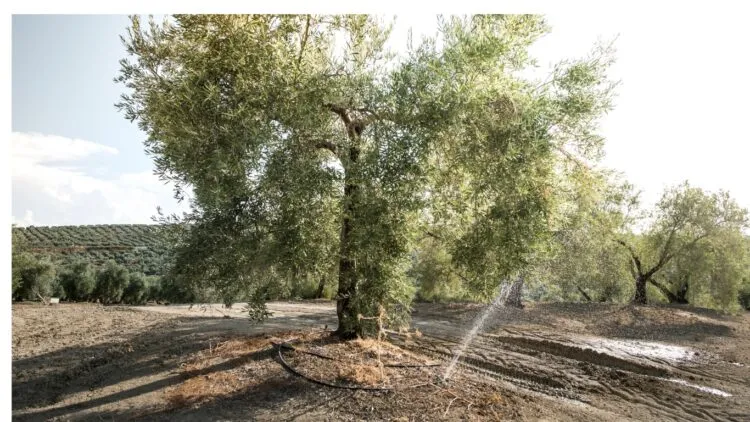
4. Nitrogen deficiency (N)
Nitrogen is the fuel for new leaves and shoots. When it is lacking, leaves turn yellow, and growth is reduced—another characteristic reason why olive trees are not growing.
Evidence: A critical July leaf nitrogen level below 1.4% indicates deficiency (Fernández-Escobar et al., 2011).
Solution: Enrich the soil with manure or organic or chemical fertilizers based on leaf analysis, or apply foliar fertilization when necessary.
For more detailed information on fertilization management, you may also read our article: Olive tree fertilization deficiency: causes, effects, and solutions.
5. Excessive fertilization
As strange as it may sound, too much fertilizer can slow down olive tree development and further contribute to why olive trees are not growing properly. Excess nitrogen promotes leaf growth but reduces fruiting.
Evidence: Excess nitrogen reduces flowering and lowers olive oil quality (Fernández-Escobar et al., 2004).
Solution: Perform annual leaf analysis. Keep fertilization rates balanced and calculate tree needs based on expected yield.
6. Lack of light—shading or dense planting
Olive trees thrive in full sunlight. When planted in shaded locations or at very high density, photosynthesis is reduced, and growth becomes stunted—explaining why olive trees do not grow under such conditions.
Evidence: Shading significantly reduces photosynthesis (Connor et al., 2014).
Solution: Prune to improve light penetration or thin trees where necessary.
7. Excessive weeds
Weeds growing near the trunk compete with olive trees for water and nutrients and often outcompete them, further explaining why olive trees are not growing as expected.
Evidence: The first 1–2 meters around the trunk are the most critical zone (Tous & Romero, 1993).
Solution: Keep a 1-meter radius around the trunk clean. Use mulching or mechanical weed control.
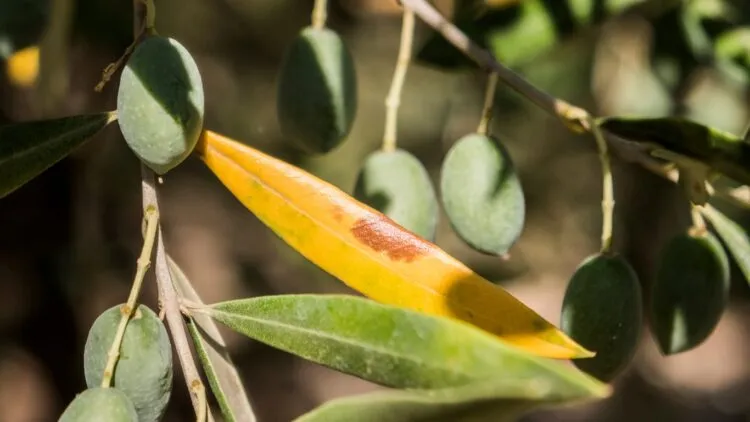
8. Root diseases
When the tree appears weak, with poor growth and yellowing leaves, root fungal diseases such as Phytophthora may be responsible, explaining why olive trees are not growing despite proper irrigation.
Evidence: Pathogenic fungi cause chronic wilting and decline (Tjamos et al., 1991).
Solution: Laboratory testing of roots and, if confirmed, chemical control of the pathogen.
9. Transplant shock
When an olive tree is transplanted, it needs time to adapt. Roots may be damaged, and growth slows until the tree establishes again—another clear answer to why olive trees are not growing in the first period after planting.
Evidence: Transplanting disrupts the balance between water absorption and transpiration (Hartmann et al., 2010).
Solution: Be patient. Protect the tree from heat stress, apply light irrigation, and avoid fertilization immediately.
10. Subsoil barriers
If compacted soil or stone layers exist in the subsoil, roots cannot expand. As a result, it becomes clear why olive trees are not growing, and the trees appear to “freeze” in development.
Evidence: Compacted soil restricts root growth and water uptake (Kalliopi et al., 2018).
Solution: Apply deep ripping or subsoiling before planting to ensure proper soil conditions.
Conclusion
The question “why olive trees are not growing” does not have a single answer. In most cases, it results from a combination of factors, including water availability, soil conditions, nutrition, sunlight, diseases, and subsoil structure. The important thing is that most of these problems can be identified early and corrected with proper monitoring, soil and leaf analyses, and targeted cultivation practices. With appropriate care, olive trees can return to normal growth rates and provide stable, high-quality production for many years.
If, after identifying the reasons why olive trees are not growing, you wish to move on to improving production, you may also read our article: Olive cultivation: 10 techniques to improve productivity.